

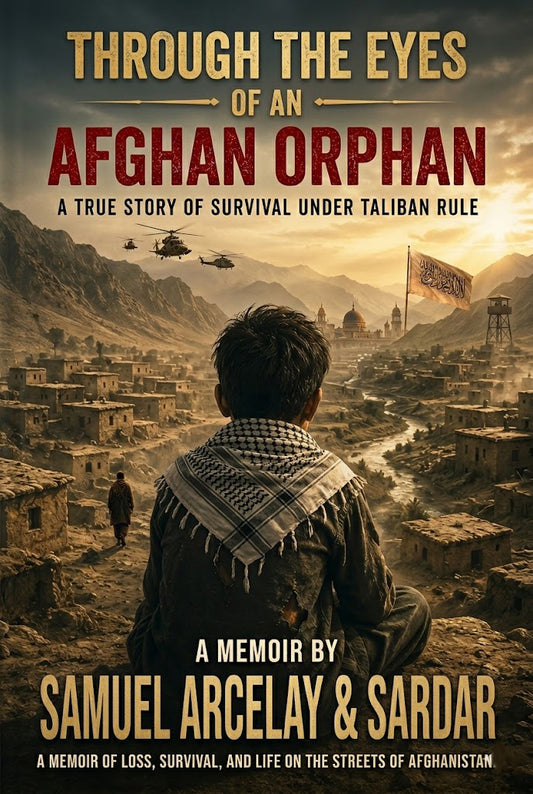
Through the Eyes of an Afghan Orphan
A True Story of Survival Under Taliban Rule
Through the Eyes of an Afghan Orphan is a powerful autobiographical memoir about survival, poverty, isolation, labor, war, and emotional endurance inside rural Afghanistan under Taliban influence and tribal traditions.
Written with raw honesty and psychological realism, this memoir takes readers beyond headlines and politics into the daily human reality of fear, hunger, loneliness, and resilience.
From orphan survival and child labor to learning English and discovering technology, Sardar’s story reveals the emotional reality of growing up forgotten by society while searching for dignity, meaning, and hope.
A deeply human memoir about survival, identity, suffering, and the desire for a better life.
-
Through the Eyes of an Afghan Orphan: A True Story of Survival Under Taliban Rule
Regular price $24.99 USDRegular price

-

My Mother Escaped With Me in Her Arms to Pakistan.
I was born in Afghanistan in the city of Kandahar, a hard and difficult place dominated by Pashtun culture and The Taliban. Almost everyone there was Pashtun, and people followed a tribal system and code of life called Pashtunwali. In that world, traditions and tribal honor controlled nearly everything. People obeyed the culture more than the law, and fear was part of daily life. My father had 3 other wives and they bullied my mother. They also tried to poison me when I was a baby. They had daughters and because of tribal tradition, I would get inheritance. My father was wealthy. My mother felt alone and powerless. One night she made a decision that would change both of our lives forever. SHE ESCAPED INTO THE NIGHT WITH ME IN HER ARMS.
-

Then one day my mother died. I was still only a boy, 12 years old. This is her grave. She was 29 years old, her name was Salima.
At that moment it felt as though my entire world collapsed. I did not know whether to cry, scream, or stay silent. My mind could not fully understand what had happened. I remember staring at people around me while feeling completely numb inside. The next morning they buried her.
I watched the funeral in confusion, standing there like a lost child trying to understand death for the first time. I remember the dust, the silence, the voices of men praying, and the terrible feeling growing inside my chest. After the burial I realized something horrifying. I had nobody left. My mother had been my only protection in the world. Without her, I was alone in a country I barely understood, surrounded by strangers, tribal rules, fear, and uncertainty. My uncle was now my only remaining connection to family. At least that is what I believed at the time. -

I was Orphaned at age 12.
After the buriaI of my mother I returned to my uncles house believing I still had my uncle and his family. Instead, I saw them packing their belongings. I asked them: “Where are we going?” Nobody answered me. I asked again. My uncle finally took me outside away from the others. His face looked nervous and serious. He told me: “You cannot come with us.”Barefooted and hungry I was l left on the streets of Afghanistan.
I felt fear move through my body. My hands started shaking. My uncle explained that I wasbecoming older now and that according to Pashtun culture, I could not continue living together with the women and girls in the family house.
He also feared that my father’s
relatives might eventually discover I was alive and come after me because of
inheritance issues. At twelve years old, I did not fully understand these things. I only understood one reality: Nobody wanted me anymore. My uncle gave me bread, water, and a blanket.Then he sent me away alone. I remember standing there holding the blanket and staring at him in disbelief.
-

I was lashed beaten and held for 3 days because The Taliban thought I was a spy.
They were meant to send a message to everyone else watching. People learned quickly that public humiliation could destroy a person’s life. I remember hearing stories about men being beaten publicly for accusations involving theft, moral crimes, or disobedience. That is one of the most dangerous things war can do to a society. It makes human suffering look ordinary.
I remember hearing adults whisper about executions and public punishments carried out in different places. Even when people disagreed privately, many stayed silent publicly because survival often depended on silence. Some people supported harsh punishments. -

Lashed with Sticks for haveing Sex Before Marriage
Sometimes people gathered in large crowds to watch punishments because fear and curiosity pulled them there. Children often witnessed these scenes too. Violence became something normal to many people because it surrounded daily life. Women are forbidden to speak in public or go to school or work and can only walk the street with father husband or brother.
-

In Afghanistan, unexploded bombsand shells remain buried in fields, roads, and villages long after fighting ends.
Children often discover them accidentally. One day I saw local boys gathered around a metal object partially buried in dirt. Curiosity pulled everyone closer. At first, we thought it was scrap
metal that could maybe be sold. But one older man suddenly began screaming for everyone to run away. It was an unexploded shell. We scattered in panic.I remember looking back while running and realizing death had been sitting quietly in front of us the entire time.That moment affected me deeply because it reflected life in Afghanistan itself. Danger often exists silently beneath ordinary life. Even the ground can kill you.
-

Lashed with sticks for talking to a girl on the phone and having sex before marriage.
He was lashed 5 times by 4 different men total 20 lashes,because he was talking to a girl on the phone and had sex with her. In Afghanistan Talin can stop and search you and your phone with no reaon, they rule by force. They check your phopne to see if you have music or pictures of opposite sex or any conversation to that indicates you are a traitor.
-

Stoned to Death for Adultery
She was stoned to death for commiting adultery. They dig a hole and put the man or woman in the hole wiast deep. Then everyone begins to throw stones at the persons head until he or she is dead.
-

Stoned to Death for Adultery
She was stoned to death for commiting adultery. They dig a hole and put the man or woman in the hole waist deep. Then they begins to throw stones at the persons head until he or she is dead.
-

Women are Forbiden to Show Face or Speak in Public
If a man speaks to a women on the street he will beaten and a woman may not leave the house unless with her brother or father and proof of marriage must be presented upon request.
-


